
Meters
T3-CHECK-1 Quantitative determination of Triiodothyronine (Total T3) in plasma or serum samples for the detection of hyperthyroid
Tax excluded. Shipping calculated at checkout
RRP: € 99.8 inc. VAT
The Thyroid hormones, thyroxine (3, 5, 3'5' – tetraiodothyronine or T4) and liothyronine (3, 5, 3'- triiodothyronine or T3) have a great effect on metabolic activity. The release of T4 and T3 from the thyroid gland is markedly influenced by the pituitary thyroid-stimulating hormone (TSH) which in turn is influenced by the hypothalamic thyrotropin- releasing hormone (TRH). Normally, increased blood levels of T4 and T3 act to decrease the amount of TSH secreted, thereby inhibiting the production and release of T4 and T3. Decreased blood levels of T4 and T3 produce the opposite effect, leading to increased production and secretion of T4 and T3. In this manner a normal circulating thyroid hormone balance is maintained. Most of the circulating T4 and T3 in the blood is bound to serum proteins, thyroxine-binding globulin (TBG), thyroxine –binding prealbumin (TBPA), and albumin. The T3 is increased in almost all cases of hyperthyroidism and usually goes up before the T4 does. Therefore the total T3 is a more sensitive indicator of hyperthyroidism that the total T4. A small fraction of T3 (0.5%) is free. This free triiodothyronine is considered to be the metabolically active form in its effect on target tissue. The free fraction of T3 is influenced not only by the total circulating T3, but also by the concentration of binding proteins in the blood. The T3-CHECK-1 is a rapid quantitative assay for the detection of Total T3 in serum or plasma to be used as a screening test for the detection of hyperthyroid The method employs a unique combination of monoclonal dye conjugate and T3 antigen coated on solid phase to identify T3 in the test samples with a high degree of specificity. As the sample flows through the absorbent device, the labelled antibody-dye conjugate binds competitively to the T3 contained in sample and to the T3 coated in the reaction zone (T). The colour intensity of the band appearing in the test zone (T) is inversely proportional to the concentration of T3 in the sample. The mixture continues flowing through the absorbent device past the reactive zone (T) and control zone (C). Unbound conjugate binds to the reagents in the control zone (C), producing a pink colour band and demonstrating that the reagents are functioning correctly.
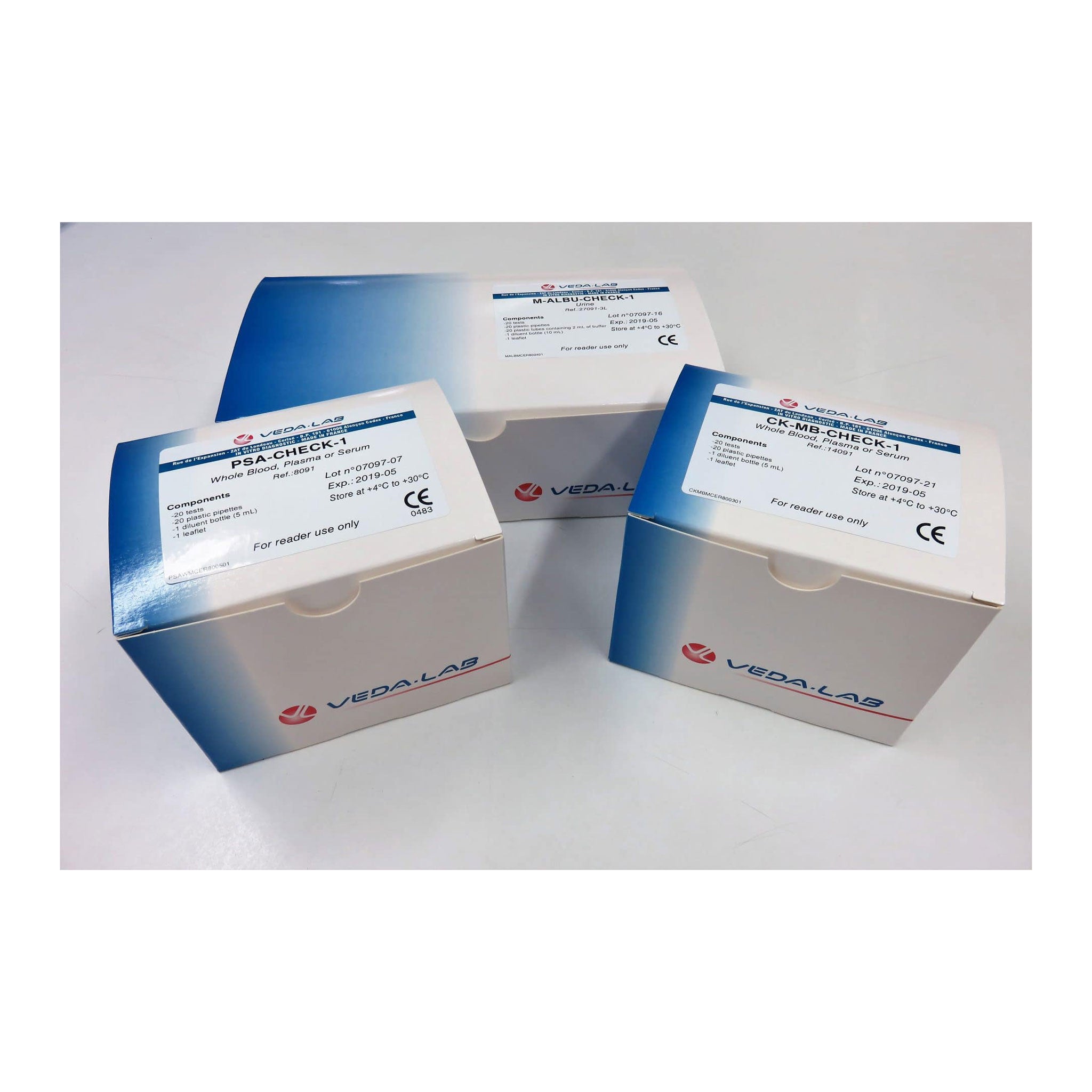
Each kit contains everything needed to perform 10 or 20 tests. - T3-CHECK-1 test devices: 10 20 - Disposable plastic pipettes: 10 20 - Diluent in a dropper bottle: 2.5 mL 5 mL - Instructions leaflet 1 1